Saturday, 25 March 2017

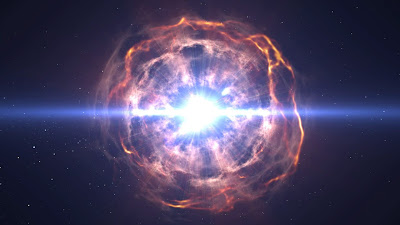




Dazzling thing in the Universe {Part -1}
Welcome to the Series of Dazzling thing in the Universe:- (Part -1)
The above symbol is called Yin Yang, it is a Taijitu meaning diagram of the supreme ultimate.
 |
| Yin Yang |
The principle of Yin Yang opposites existing in harmony, is associated with ancient Chinese philosophy.
But the very first use of the iconography the class symbol,, actually comes from a Shield pattern used by the ancient Romans 700 years before.
Its first known use in China.
A connection between the two yet to be found. Regardless of who came up with it first, the symbol was a bright idea.
But what's the brightest thing in the Universe?
Well, Apparent Magnitude.
 |
| Apparent Magnitude |
Commonly used when stargazing refers to how bright an object appears to us, say when looking up from Earth.
It depends upon Earth-centric factors, like how close the object is to our planet.
Magnitudes are logarithmic and arranged like golf, where a smaller number means a greater brightness.
But today, I'm looking for Absolute Magnitude, a measure of how bright things all over the Universe near and far would be if we looked at them from the same distance.
Absolute Magnitude will guide us to the most blending light in the Universe, irrespective of it looking faint to us here on Earth, just because its far away.
The difference is significant.
A 100-watt light bulb placed closer than 8 centimetres will appear brighter than the Sun in the sky. But that's not fair.
If you could see the Sun and the bulb from the same distance, the Sun would be a septillion times brighter.
That's bright.
If you could line up the Sun up with everything else out there giving every star a cosmological phenomena, a fair chance, the Sun's Absolute Magnitude would 4.8.
But check out R136a1. This star isn't the brightest star in terms of volume but it is 256 times more massive than our Sun.
 |
| R136a1 |
It's the most massive star ever found and it's also the brightest.
Tuesday, 14 March 2017
Hottest thing in the Universe {Part -4}
Welcome to the Series of Hottest thing in the Universe:- (Part -4)
Okay, what if we add even more energy?
Wouldn't the wavelength get smaller? It's supposed to, but yet it ain't. This is where we've got a problem.
Above 1.41 times to 32 kelvin, the Planck temperature, our theories don't work.
The object would become hotter than temperature. It would be so hot that what it is would not be considered a temperature.
Theoretically, there is no limit to the amount of energy we could keep adding into the system. We just don't know what would happen if it got hotter than the Planck temperature.
Classically, you could argue that that much energy in one place would instantly cause a Black Hole (don't forget to check my other posts- "Journey to the Black Hole") to form.
And a Black Hole formed from energy has a special name- a Kugelblitz.
So, basically, what I'm trying to say is when you want to tell someone you like that you think they are hot,so hot that not even science can understand it, Just call them a Kugelblitz.
Finally, here is something fun.
The Sun is about 4.7 billion years old, about halfway through its life cycle and so far it has burned 100 Earths worth of fuel,
which sounds like a lot, but the Sun is the size of 300,000 Earths.
Because of that discrepancy, you can have a lot of mathematical fun comparing your energy output to the Sun's.
The Sun is way hotter than us and it puts out way more energy than us.
Some websites have a lot of fun with this one and although it doesn't really mean anything anything, it is technically true,
because of the Sun's enormous size, that one cubic centimeter of human puts out more energy than an average cubic centimeter of the Sun, which should make you feel quite warm inside.
Okay, what if we add even more energy?
Wouldn't the wavelength get smaller? It's supposed to, but yet it ain't. This is where we've got a problem.
Above 1.41 times to 32 kelvin, the Planck temperature, our theories don't work.
The object would become hotter than temperature. It would be so hot that what it is would not be considered a temperature.
Theoretically, there is no limit to the amount of energy we could keep adding into the system. We just don't know what would happen if it got hotter than the Planck temperature.
Classically, you could argue that that much energy in one place would instantly cause a Black Hole (don't forget to check my other posts- "Journey to the Black Hole") to form.
And a Black Hole formed from energy has a special name- a Kugelblitz.
So, basically, what I'm trying to say is when you want to tell someone you like that you think they are hot,so hot that not even science can understand it, Just call them a Kugelblitz.
Finally, here is something fun.
The Sun is about 4.7 billion years old, about halfway through its life cycle and so far it has burned 100 Earths worth of fuel,
which sounds like a lot, but the Sun is the size of 300,000 Earths.
 |
| Planets in our Solar System compared to the Sun |
Because of that discrepancy, you can have a lot of mathematical fun comparing your energy output to the Sun's.
The Sun is way hotter than us and it puts out way more energy than us.
 |
| The Sun |
Some websites have a lot of fun with this one and although it doesn't really mean anything anything, it is technically true,
because of the Sun's enormous size, that one cubic centimeter of human puts out more energy than an average cubic centimeter of the Sun, which should make you feel quite warm inside.
Subscribe to:
Comments (Atom)