Translate in your Language

Showing posts with label Solar System. Show all posts

Tuesday, 14 February 2017

Proteus (Neptune's Moon) - (Important Facts) {Part-52}

NORMALLY, BODIES OVER ABOUT 200 km/ 125 mi in radius will have sufficient mass to form a sphere, but despite Proteus measuring around 210 km/ 130 mi in radius, it has a very irregular surface, featuring concave depressions and ridges up to 20 km/ 12.4 mi high.

Proteus- Shubham Singh (Universe)
Proteus
The surface is dark and heavily cratered with the largest moon than 250 km/ 155 mi in diameter with a depth of 20 km/ 12.4 mi.
It is likely that Proteus formed from debris cratered by collisions between Neptune's smaller moons, the result of disrupted orbits caused by the capture of Triton

Sunday, 12 February 2017

Triton (Neptune's Moon) - (Important Facts) {Part-51}

THE LARGEST MOON OF NEPTUNE, and comprising 98% of the mass orbiting the planet, Triton is the only the moon in the Solar System to have a retrograde orbit, meaning it orbits in the opposite direction to all other moons.

Triton- Shubham Singh (Universe)
Triton
Because of its orbit, it is thought that the moon was once a Kuiper belt object like Pluto that was captured by Neptune's gravity.
Triton is also one of the few moons of the Solar System to be volcanically active, however due to the very low temperature far from the Sun, its volcanoes erupt water and ammonia rather than liquid rocks.
Surface of Triton- Shubham Singh (Universe)
Surface of Triton
It is large enough for its interior to have differentiated into a rocky/metallic core under an icy mantle. The contains enough mass that radioactive decay might be warming it from the inside, which could be responsible for the Cryovolcanic activity.

Cryovolcanic activity- Shubham Singh (Universe)
Cryovolcanic activity
In addition to cryovolcanoes, Triton also exhibits geysers, which erupt with gaseous nitrogen for up to a year at a time.
Triton geysers- Shubham Singh (Universe)
Triton Geysers
Because of constant volcanic activity, Triton's surface relatively young having wiped away almost all signs of impact craters.

Saturday, 11 February 2017

Ariel (Uranus' Moon) - (Important Facts) {Part-50}

OF THE 27 KNOWN MOONS OF URANUS, of which only five are large enough to have a spherical shape, Ariel is the brightest.

Ariel- Shubham Singh (Universe)
Ariel
Formed form the material in orbit around Uranus, quite possibly as the result of the impact that tipped the planet onto its side , the moon is differentiated. Approximately 64% of its mass is a rocky core, with ice accounting for the rest.
The moon's fissured surface reveals evidence of the relatively recent tidal heating of its core, but it is unlikely that it is currently warm enough for liquid water to exist under the surface.

Pics of Ariel- Shubham Singh (Universe)
Pics of Ariel

Friday, 10 February 2017

Umbriel (Uranus' Moon) - (Important Facts) {Part-49}

UMBRIEL'S SURFACE IS HEAVILY CRATERED and is the darkest of the major Uranian moons.

Umbriel- Shubham Singh (Universe)
Umbriel
Composed mostly of water ice, it is thought that the moon features a distinct rocky core that totals about 40% of its mass. The interior of the moon is not likely to be warm enough to support sub-screen ocean.

Physical characteristics of Umbriel- Shubham Singh (Universe)
Physical Characteristics of Umbriel
Umbriel's most prominent feature is Wunda crater, an impact crater with a diameter of 13 km/ 81m, that features a bright ring of material on its floor, believed to be residue of the object that collided with the moon.

Wunda Crater- Shubham Singh (Universe)
Wunda Crater


Thursday, 9 February 2017

Titania (Uranus' Moon) - (Important Facts) {Part-48}

TITANIA IS COMPOSED OF EQUAL quantities of rock and ice, differentiated into distinct layers, with the possibility of liquid water where the ice meets the core.

Titania- Shubham Singh (Universe)
Titania
The largest of the Uranian moons, Titania is the 8th largest moon in the Solar System.

Physical characteristics of Titania- Shubham Singh (Universe)
Physical characteristics of Titania
Its surface is criss-crossed with huge cracks caused by expansion as it cooled after formation, but it features fewer craters than Uranus' other moons, indicating that it has been resurfaced in the past.

Wednesday, 8 February 2017

Oberon (Uranus' Moon) - (Important Facts) {Part-47}

ALTHOUGH ONLY THE SECOND LARGEST, Oberon is the most massive and outermost moon of Uranus.

Oberon- Shubham Singh (Universe)
Oberon
Like Uranus' other moons, Oberon is composed of equal quantities of ice and rock and is likely to have a defined core, with the possibility of a layer of liquid water surrounding it, if the water contains sufficient quantities of ammonia to stop it freezing.

Facts of Oberon- Shubham Singh (Universe)
Facts of Oberon
The reddest of the Uranian moons, Oberon also has the highest number of impact craters, indicating that its surface is the oldest. It also features large cracks, the result of expansion while its core was cooling.

Monday, 6 February 2017

Phobos (Mars' Moon) - (Important Facts) {Part-45}

PHOBOS, THE SMALLER AND CLOSER  of Mars' two moons, has an orbital speed of the red planet. As seen from the surface of the Mars, Phobos will rise and set twice each day.


Phobos- Shubham Singh (Universe)
Phobos
The moon's orbital speed is gradually decreasing and it is estimated that in around 11 million years it will either crash into Mars or tidal forces will break it up and form a ring system.
The origin of Phobos is unknown, but like Deimos, it is possible that it was an asteroid that was captured by Mars gravitational field.
With a density too low for it to be solid rock, it is believed that it is largely composed of ice surrounded by a layer of accumulated rock and dust, at least 100 m /328 ft thick.

Craters of Phobos- Shubham SIngh (Universe)
Craters of Phobos
The regolith on the leading face of the moon is marked with grooves and streaks thought to be caused by collisions with material thrown into the moon's path by impacts on Mars in the past.

Saturday, 28 January 2017

Mimas (Saturn's Moon) - (Important Facts) {Part-44}

MIMAS, AT 198km/123mi, a smallest body that can be for its own gravity to caused it to settle into spherical shape.

Mimas- Shubham Singh (Universe)
Mimas
With a very low density, Mimas is largely composed of water ice, with a small quantity of rock.
The most striking feature of the moon is an enormous crater 130km/81mi across, giving it an appearance not unlike the 'Death Star' in the Star Wars movies. This is a coincidence as detailed photos of the moon were only three years after the movie was made.

Friday, 27 January 2017

Enceladus (Saturn's Moon) - (Important Facts) {Part-43}

ENCELADUS IS A GEOLOGICALLY ACTIVE MOON with a patchy surface showing evidence of ancient craters and relatively smooth plains with extensive grooving, the result of tectonic activity.

Enceladus- Shubham Singh (Universe)
Enceladus
The Cassini probe discovered that the moon has active volcanoes and plumes of water rich material have been witnessed venting into space from Geysers, ending up in orbit around Saturn as part of one of its rings.


Structure of Enceladus- Shubham Singh (Universe)
Structure of Enceladus
Although the surface of the moon is largely water ice, it features a large rocky core. Heating of this core by tidal forces and radioactive decay drives geological activity on the moon.
The plumes of water out-gassing from Enceladus have been found to contain salt, suggesting that the water is being heated underground and that it originates from large caverns or even an ocean of liquid salt water.

Plumes of water out-gassing from Enceladus- Shubham Singh (Universe)
Plumes of water out-gassing from Enceladus
This discovery makes Enceladus one of the most favourable places in the Solar System to search for life.


Thursday, 26 January 2017

Tethys (Saturn's Moon) - (Important Facts) {Part-42}

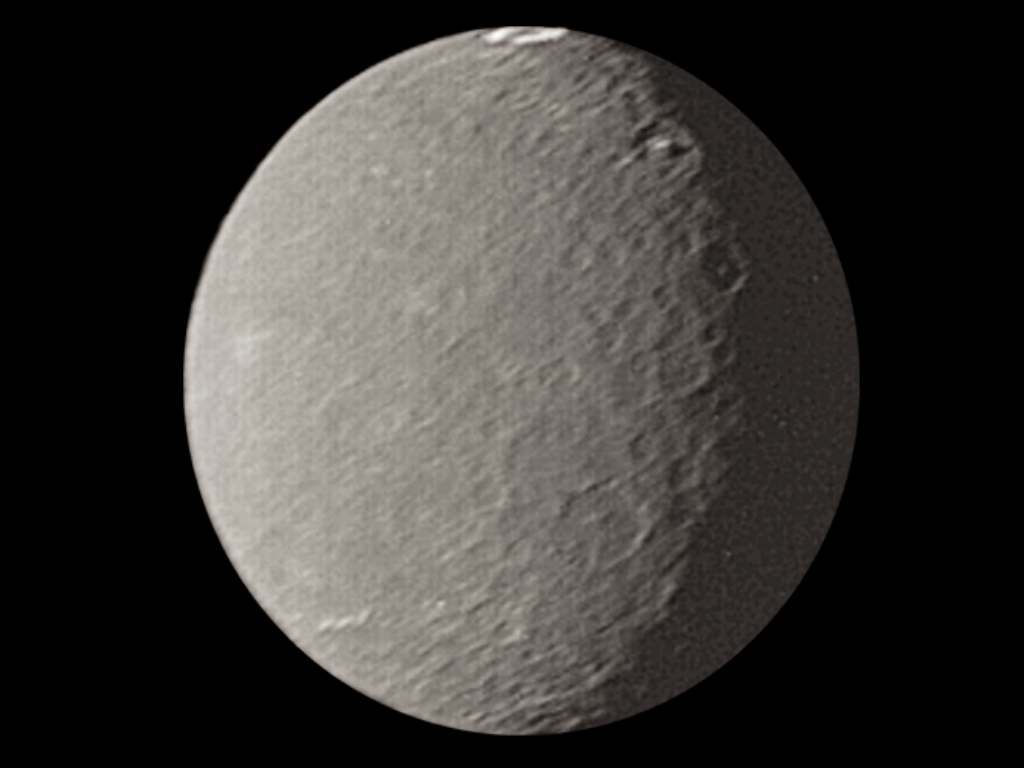
COMPOSED ALMOST ENTIRELY OF WATER ICE, Tethys is one of the most reflective objects in the Solar System, having been polished by ice particles in Saturn's rings. As the moon is tidally locked, the leading face is brighter due to this polishing.

Tethys- Shubham Singh (Universe)
Tethys
Apart from impact craters, Tethys features a huge chasm, 100km/62mi wide and 3km/19mi deep, that runs nearly three quarters of the way around the moon, 2,000km/1,243mi in length. This is caused by freezing liquids and expanding as the core cooled, cracking the surface.

Diameter comparison of the Saturnian moon Tethys, Moon, and Earth- Shubham Singh (Universe)
Diameter comparison of the Saturnian moon Tethys, Moon, and Earth. Credit: NASA/JPL/USGS/Tom Reding
Like most of Saturn's major moons, it was created from the cloud of material left in orbit after Saturn formed.
With a mean radius of 531.1 ± 0.6 km and a mass of 6.1745 ×10²⁰ kg, Tethys is equivalent in size to 0.083 Earths and 0.000103 times as massive. Its size and mass also mean that it is the 16th-largest moon in the Solar System, and more massive than all known moons smaller than itself combined. At an average distance (semi-major axis) of 294,619 km, Tethys is the third furthest large moon from Saturn and the 13th most distant moon over all.

Wednesday, 25 January 2017

Dione (Saturn's Moon) - (Important Facts) {Part-41}

DIONE FEATURES A LARGER ROCKY CORE, accounting for approximately one third of the moon's mass, with the rest composed largely or water ice.

Dione- Shubham Singh (Universe)
Dione
The moon's surface is heavily cratered though unusually, most of the craters are on the trailing face of the moon, suggesting that at some point in its history, a significant impact spun it 180 degrees, leaving it effectively facing 'backwards' as it orbits Saturn.

.Dione is the fourth-largest moon of Saturn, with a diameter of 698 miles (1,123 kilometres).
 It is the 15th largest moon in the solar system.
Dione orbits around Saturn once every 2.7 Earth-days, at a distance of 234,000 miles (377,400 km), approximately the same distance from Earth to its moon.

Comparison of Dione with other moons of Saturn- Shubham Singh (Universe)
Saturn's Moon
The trailing hemisphere of the moon is also riddled with bright ice cliffs, the result of huge tectonic fractures.

Tuesday, 24 January 2017

Rhea (Saturn's Moon) - (Important Facts) {Part-40}

THE SECOND LARGEST MOON IN THE SATURN SYSTEM, Rhea has a composition, appearance and brightness similar to Dione.

Rhea- Shubham Singh (Universe)
Rhea
Around 25% rocky material and 75% water ice, despite its mass giving it the status of the ninth largest moon in the Solar System, it is believed that Rheas's interior is not differentiated. Its structure is a mixture of rock and ice with no defined core.

Like Titan, Rhea has an atmosphere composed of oxygen and carbon dioxide, though it is so thin as to be barely visible. Oxygen in the atmosphere is the result of water ice on Rhea's surface breaking down, but it is not clear where the carbon dioxide originates.

A false colour image of Rhea- Shubham Singh (Universe)
A false colour image of Rhea


Monday, 23 January 2017

Titan (Saturn's Moon) - (Important Facts) {Part-39}

TITAN IS THE SECOND LARGEST MOON in the Solar System, the largest moon of Saturn and is the only moon with a thick atmosphere.

Titan- Shubham Singh ()Universe)
Titan
Its radius is nearly 50% larger than Luna, but it has a lower density, giving it a mass and surface gravity that is around 80% of our Moon.

Structure of Titan
The surface is shrouded in an atmosphere that is 98% nitrogen with clouds of methane, ethane and nitrogen-rich organic smog.
In December 2004, the Huygens lander successfully touched down on Titan revealing world that is strikingly similar to our own, but at a much colder temperature.

Huygens in Titan- Shubham Singh (Universe)
Huygens in Titan

Featuring seas of liquid ethane or methane shorelines, sand dunes composed of organic material and terrain that has been weathered by methane rains. Titan is also geologically active, with water ice volcanoes and tectonic activity.
Titan's current state is very similar to the young Earth, with the exception of it lacking water vapour in the atmosphere, making it a prime candidate in the search for life.


Search for Life on Titan- Shubham Singh (Universe)


Saturday, 21 January 2017

Iapetus (Saturn's Moon Series) - (Important Facts) {Part-38}

COMPOSED MOSTLY OF WATER ICE, Iapetus'  most striking features is an equatorial ridge, the dark colouring of its leading face and the light colour of its trailing face.

Iapetus- Shubham Singh (Universe)
Iapetus
The colours are likely caused by evaporation of water ice in the leading face leaving behind a dark residue.
It is not known how the equator ridge formed or why it runs along the equator of the moon.


Mystery of Iapetus- Shubham SIngh (Universe)
Mystery of Iapetus

View of Iapetus- Shubham Singh (Universe)
View of Iapetus
One possibility is that the young Iapetus was spinning faster then it is now, and if it cooled unevenly while slowing down, then the equator could have frozen before the polar regions, which might preserved the flattened spherical shape it had due to the speed of its rotation.

Friday, 20 January 2017

Callisto (Jupiter's Moon Series) - (Important Facts) {Part-37}

NEARLY THE SAME SIZE AS MERCURY, Callisto is the third largest moon in the Solar System.

Callisto- Shubham Singh (Universe)
Callisto
It is composed of almost equal amounts of rock, and ice, but is only partially differentiated with no defined core or mantle. It is suggested that the moon grew slowly over a great deal of time by collecting particles that were left in orbit after Jupiter formed.

Structure of Callisto- Shubham Singh (Universe)
Structure of Callisto
Because it was slow, heat dissipated so the layers we typically see in other large bodies didn't form.
Callisto's surface is heavily cratered and ancient, featuring no signs of geological activity. It also possesses a tenuous carbon-dioxide atmosphere.

Ocean inside Callisto- Shubham Singh (Universe)
Ocean inside Callisto

A salt water ocean may exist deep within the moon, but conditions for life aren't as favourable as they are on its neighbours, Europa and Ganymede.


Thursday, 19 January 2017

Ganymede (Jupiter's Moon Series) - (Important Facts) {Part-36}

GANYMEDE IS THE LARGEST MOON in the Solar System, larger than Titan by just 2%, and is composed of water ice surrounding a rocky mantle and an iron core, ice accounts for almost half the moon's mass.

Ganymede- Shubham Singh (Universe)
Ganymede
Like Europa, Ganymede shows evidence of a liquid salt-water ocean deep under its icy surface, warmed by tidal forces acting on the moon's core.

Structure of Ganymede- Shubham Singh (Universe)
Structure of Ganymede
The surface is covered in ancient dark patches which are saturated by impact craters, and less ancient lighter patches featuring grooves and ridges. It is not known why these two surface types exist , but it may have something to do with tectonic activity caused by tidal heating.

Craters of Ganymede- Shubham Singh (Universe)
Craters of Ganymede
Ganymede features a very thin oxygen atmosphere, the result of water ice on its surface being broken down by radiation from Jupiter.

Wednesday, 18 January 2017

Europa (Jupiter's Moon Series) - (Important Facts) {Part-35}

EUROPA HAS THE SMOOTHEST SURFACE of anybody in the Solar System,

Europa- Shubham Singh (Universe)
Europa
with the most common feature being the dark bands on its surface, some of which are 20km/12mi across. These are caused by flexing due to tidal forces, cracking the surface ice and revealing salty water which leaves behind dark stains as it evaporates.

Structure of Europa- Shubham Singh (Universe)
Structure of Europa
Nearly as large as Luna, Europa features a solid iron core, a rocky mantle, and surface ice layer around 100km/62mi thick.
Tidal stresses heating the moon's core are thought to provide enough warmth to allow a liquid salt water ocean to exist under the ice, making Europa another target in the search of life.
Other evidence for the sub-surface ocean includes the lack of impact craters, indicating that the body was relatively recently resurfaced, means that there is probably a heat source inside the moon (Europa).

Comparison between Earth and Europa- Shubham Singh (Universe)
Comparison between Earth and Europa

Tuesday, 17 January 2017

Io (Jupiter's Moon Series) - (Important Facts) {Part-34}

Note:- Hello everybody, Welcome to the Series of Jupiter's Moon.

THE CLOSEST MOON TO JUPITER'S and slightly larger than our Luna, Io is the most geologically active body in the Solar System, with over 400 active volcanoes on its surface.

Io- Shubham Singh (Universe)
Io
Unlike most of the other moons in the moons in the Solar System which feature water based volcanism, the magma produced by Io's volcanoes is actually liquid rock, heated to high temperature by tidal forces from Jupiter and its other moons.

Volcanic Eruption in Io- Shubham Singh (Universe)
Volcanic Eruption in Io
Extensive mountain ranges are produced by tectonic activity, not the abundant volcanoes, in the same way that mountains from on Earth, reaching heights of up to 18km/11.2mi, averaging about 6km/3.7mi.

Structure of Io- Shubham Singh(Universe)
Structure of Io
The mottled, largely yellow and brown surface is a result of sulphur compounds from volcanoes and sulphur dioxide frost that condenses out of Io's thin atmosphere. Interaction of charged particles from Jupiter with this atmosphere produces Auroras in Io's skies.

The moon is largely composed of rock surrounding a molten iron or iron sulfide core and due to the large scale volcanism which is constantly resurfacing it, there are no visible impact craters on the surface.

Monday, 16 January 2017

Eris (Asteroid Series) - (Important Facts) {Part-33}

ERIS IS THE MOST MASSIVE dwarf planet in the Solar System and is also the ninth most massive object to directly orbit the Sun.

Eris- Shubham Singh (Universe)
Eris
It was discovered in January 2005 by Mike Brown and his team at Palomar Observatory.
If you’re not sure why astronomers suddenly decided that Pluto wasn’t a real planet after all,It’s all because of Eris.
Due to its size, it was initially described as then tenth planet. To avoid adding Ceres and other large object to the planet category, the IAU decided to move Pluto to dwarf planet category.

Eris' Orbital plane- Shubham Singh (Universe)
Eris' Orbital plane
Eris is named after the goddess Eris, a personification of strife and discord.

Goddess Eris- Shubham Singh (Universe)
Goddess Eris
The dwarf planet is believed to have a rocky core with outer layers composed of water ice and frozen gasses such as methane. Because of its large size, if it does have a rocky core, it may have sub-surface oceans, heated by radioactive decay.

Sunday, 15 January 2017

Vesta (Asteroid Series) - (Important Facts) {Part-32}

VESTA IS THE SECOND largest asteroid in the Solar System and when it was first discovered, it was mis-classified as a Planet along with the other three known asteroids at the time, Ceres, Pallas and Juno.

Vesta- Shubham Singh (Universe)
Vesta
Its mass totals estimated 9% of all the mass contained in the Asteroid Belt, and like Ceres, it is at least partially differentiated, but it is not classed as a dwarf planet because its mass falls just under the necessary threshold.

Structure of Vesta - Shubham Singh (Universe)
Structure of Vesta
Vesta's most dominant feature is a huge crater, 460km/290mi across, caused by an impact that occurred one billion years ago, resulting in it losing about 1% of its mass. Some of this material eventually found its way to the Earth where it has since been recovered by scientists.