Translate in your Language

Showing posts with label Jupiter's Moon. Show all posts

Friday, 20 January 2017

Callisto (Jupiter's Moon Series) - (Important Facts) {Part-37}

NEARLY THE SAME SIZE AS MERCURY, Callisto is the third largest moon in the Solar System.

Callisto- Shubham Singh (Universe)
Callisto
It is composed of almost equal amounts of rock, and ice, but is only partially differentiated with no defined core or mantle. It is suggested that the moon grew slowly over a great deal of time by collecting particles that were left in orbit after Jupiter formed.

Structure of Callisto- Shubham Singh (Universe)
Structure of Callisto
Because it was slow, heat dissipated so the layers we typically see in other large bodies didn't form.
Callisto's surface is heavily cratered and ancient, featuring no signs of geological activity. It also possesses a tenuous carbon-dioxide atmosphere.

Ocean inside Callisto- Shubham Singh (Universe)
Ocean inside Callisto

A salt water ocean may exist deep within the moon, but conditions for life aren't as favourable as they are on its neighbours, Europa and Ganymede.


Thursday, 19 January 2017

Ganymede (Jupiter's Moon Series) - (Important Facts) {Part-36}

GANYMEDE IS THE LARGEST MOON in the Solar System, larger than Titan by just 2%, and is composed of water ice surrounding a rocky mantle and an iron core, ice accounts for almost half the moon's mass.

Ganymede- Shubham Singh (Universe)
Ganymede
Like Europa, Ganymede shows evidence of a liquid salt-water ocean deep under its icy surface, warmed by tidal forces acting on the moon's core.

Structure of Ganymede- Shubham Singh (Universe)
Structure of Ganymede
The surface is covered in ancient dark patches which are saturated by impact craters, and less ancient lighter patches featuring grooves and ridges. It is not known why these two surface types exist , but it may have something to do with tectonic activity caused by tidal heating.

Craters of Ganymede- Shubham Singh (Universe)
Craters of Ganymede
Ganymede features a very thin oxygen atmosphere, the result of water ice on its surface being broken down by radiation from Jupiter.

Wednesday, 18 January 2017

Europa (Jupiter's Moon Series) - (Important Facts) {Part-35}

EUROPA HAS THE SMOOTHEST SURFACE of anybody in the Solar System,
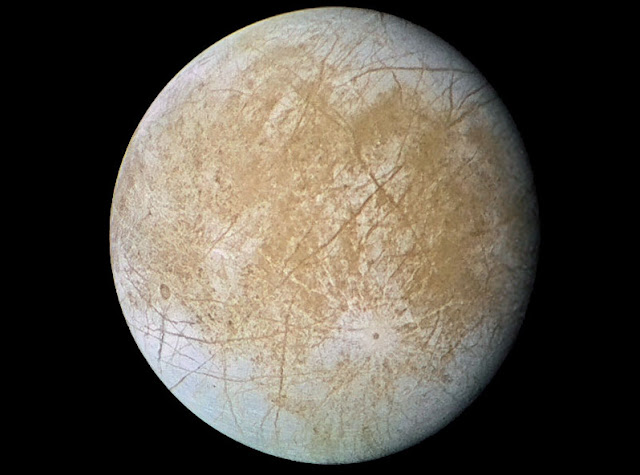
Europa- Shubham Singh (Universe)
Europa
with the most common feature being the dark bands on its surface, some of which are 20km/12mi across. These are caused by flexing due to tidal forces, cracking the surface ice and revealing salty water which leaves behind dark stains as it evaporates.
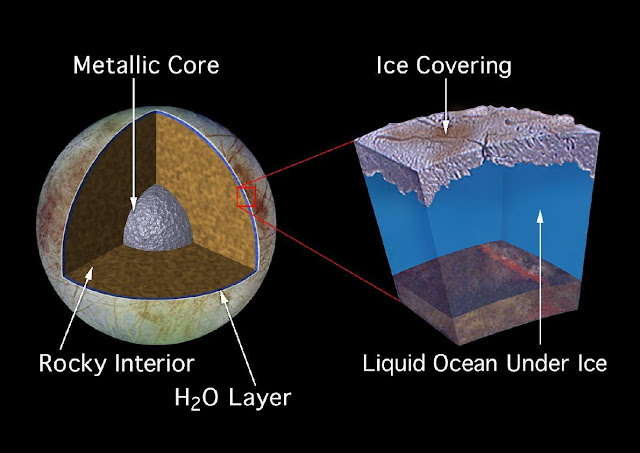
Structure of Europa- Shubham Singh (Universe)
Structure of Europa
Nearly as large as Luna, Europa features a solid iron core, a rocky mantle, and surface ice layer around 100km/62mi thick.
Tidal stresses heating the moon's core are thought to provide enough warmth to allow a liquid salt water ocean to exist under the ice, making Europa another target in the search of life.
Other evidence for the sub-surface ocean includes the lack of impact craters, indicating that the body was relatively recently resurfaced, means that there is probably a heat source inside the moon (Europa).
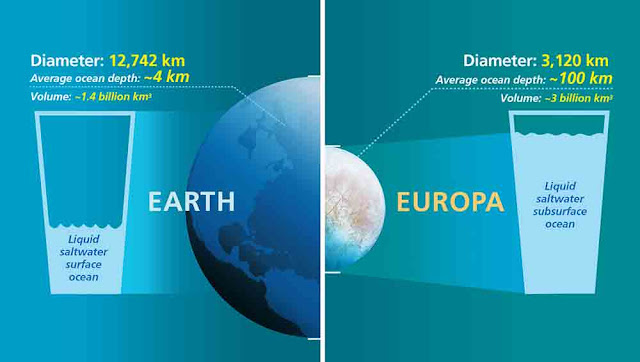
Comparison between Earth and Europa- Shubham Singh (Universe)
Comparison between Earth and Europa

Tuesday, 17 January 2017

Io (Jupiter's Moon Series) - (Important Facts) {Part-34}

Note:- Hello everybody, Welcome to the Series of Jupiter's Moon.

THE CLOSEST MOON TO JUPITER'S and slightly larger than our Luna, Io is the most geologically active body in the Solar System, with over 400 active volcanoes on its surface.

Io- Shubham Singh (Universe)
Io
Unlike most of the other moons in the moons in the Solar System which feature water based volcanism, the magma produced by Io's volcanoes is actually liquid rock, heated to high temperature by tidal forces from Jupiter and its other moons.

Volcanic Eruption in Io- Shubham Singh (Universe)
Volcanic Eruption in Io
Extensive mountain ranges are produced by tectonic activity, not the abundant volcanoes, in the same way that mountains from on Earth, reaching heights of up to 18km/11.2mi, averaging about 6km/3.7mi.

Structure of Io- Shubham Singh(Universe)
Structure of Io
The mottled, largely yellow and brown surface is a result of sulphur compounds from volcanoes and sulphur dioxide frost that condenses out of Io's thin atmosphere. Interaction of charged particles from Jupiter with this atmosphere produces Auroras in Io's skies.

The moon is largely composed of rock surrounding a molten iron or iron sulfide core and due to the large scale volcanism which is constantly resurfacing it, there are no visible impact craters on the surface.