Translate in your Language

Showing posts with label Universe. Show all posts

Saturday, 2 March 2019

Warmhole -Space Talks#7

A highly speculative idea of modern astrophysics, warmholes are theoretical possibilities allowed within the mathematical framework of Einstein's general theory of relativity. A warmhole is a short-lived portal, lasting only a brief moment, that joints two black holes in different locations.

Warmhole
Warmholes could connect two points in the present-day universe or, perhaps, in different times. In warmhole theory, matter falling into a black hole at one point should emerge through a proposed "White Hole"-- the reverse of a black hole-- at the other end (Travelers could go from point to point in time or space through warmholes, as imagined here in the picture).
Neither wormholes nor any evidence of them has yet observed. Scientists cannot determine how they would be created, although astrophysics such as Hawking continue to work on this intriguing notion.


Tuesday, 26 February 2019

The Zodiac -Space Talks#6

The Zodiac is a band of constellations that extends roughly nine degrees on each side of the ecliptic, the sun's apparent yearly path through our sky.

Constellations of the Zodiac

Ancient Greek astronomers divided the zodiac into 12 parts. Over time, Earth's slight rotational wobble has shifted the ecliptic by more than 30 degrees against the backdrop of stars. The 18-degree-wide now also includes parts of Cetus (the Whale) and Orion (the Hunter).
Constellations seen from the Northern Hemisphere became standardized through the observations of ancient Western and Middle Eastern cultures. Those of the Southern Sky were named mostly by European ocean voyagers.

Monday, 20 August 2018

Constellations -Space Talks#5

Stars seem to move across the sky through the night, but that movement is due to Earth's rotation. As Earth spins on its axis, objects appear to rise in the east and set in the west. In the Northern Hemisphere, some stars never appear to  set, called Circumpolar Stars, they circle at a point projected in the sky above the Northern Pole near Polaris, the Pole Star. A corresponding situation exists above the South Pole near the Star Sigma Octantis.

Constellations

In ancient cultures, sky-watching played an important role in navigation, agriculture, religion and even entertainment. Those who observed the heavens connected stars to form patterns that related to the heroes, gods and legends of their culture-- what we refer to today as Contellations.
Most cultures named constellations and attached cultural meaning to their patterns. Native American sky lore, for instance, often used constellations to teach moral lessons.
Today, the Western world acknowledges the constellations that originated in Mesopotamia more than 5,000 years ago. Babylonian, Egyptian, and Greek astronomers also made contributions during the classical ages of their cultures.
In 1928 the International Astronomical Union (IAU) determined which constellations would be officially recognized. Of the 88 constellations on the IAU list, 48 were identified in ancient times with just the naked eye. The remaining 40 were added in more recent centuries.

Thursday, 21 September 2017

Discovery of Big Bang -Space Talks# 4

The first scientific evidence for the Big Bang was found in 1929, when astronomers discovered that light from distant galaxies is rendered. This color change happens when objects are moving away from us, making light waves stretch out and change color. The more distant the galaxies are, the faster they rushing away. This shows that the whole Universe is expanding.

No charge in starlight
Light waves stretched

Big Bang afterglow:-

More evidence of the Big Bang came in the 1960s, when astronomers detected faint microwave radiation coming from every point in the sky. This mysterious energy is the faded remains of the intense burst of energy released in the Big Bang.

Microwave map of whole sky

Changing elements:-

For hundreds of millions of years, the Universe consisted almost entirely of hydrogen and helium- the very simplest chemical elements.
After stars appeared, new elements began to be made in the cores of dying stars. All the complex elements in our bodies were forged in dying stars this way.

Big Bounce theory:-
What caused the Big Bang? We may never know for sure, but some scientists have suggested that there may have been lots of big bangs, with the Universe expanding after each one and then shrinking again. This theory is called the Big Bounce because the process repeats itself.
 

Wednesday, 20 September 2017

Star death- Space Talks# 3

All stars eventually run out of fuel and die. Most fade away quietly, but the most massive stars self-destruct in a huge explosion that can outshine an entire galaxy.

Like Earth, stars generate the force of gravity which squeezes their hot core. The more matter a star has, the greater the force of gravity and the hotter and denser the core becomes. The way a star dies depends on how powerfully its core is squeezed by gravity.


Stars make heat and light by the process of nuclear fusion: hydrogen atoms in the core crash together to form helium, releasing energy. In small stars, when hydrogen in the core runs out, the stars light slowly fades. But in more massive stars, the core is so hot and dense that fusion can spread beyond it, changing the star's appearance. The most massive stars are eventually overwhelmed by their own gravity, which crushes them so violently that they collapse into a pinprick to a create a black hole.

Ways to die:-
Stars can die in four different ways, all of which are shown on these pages. Our Sun, a typical star, will follow the central path, but not yet - it has enough fuel to keep shinning for 5 billion years. When larger stars die, they turn hydrogen into heavier chemical elements such as carbon and oxygen, which are later recycled to form new stars and planets. All the atoms in your body were created this way.


Tuesday, 19 September 2017

Seeing the invisible- Space Talks# 2

Professional astronomers don't just use visible light to see the night sky. Their telescopes can also create images from wavelengths of light that our eyes cannot see, such as X-rays, radio waves and infrared rays. The images below all show kepler's Supernova - the wreckage left by a giant star that exploded in 1604.


X-ray image:- 

X-ray image of Kepler's Supernova

    X-ray image of Kepler's Supernova

This image of Kepler's Supernova is from the orbiting Chandra X-ray Observatory. It shows a cloud of incredibility hot gas that emits high-energy X-rays. 
Visible light image:-


Visible light image of Kepler's image
Very little of the object can be seen in visible light, even in this image from the Hubble Space Telescope. The bright areas are clumps of gas.
Infrared image:-

Infrared image of Kepler's image

Taken by the Spitzer Space Telescope, this infrared image shows dust clouds that were heated by a shock wave from the exploding star.


Combined image of Kepler's image
 Combining all three sources produces a complete image: a shell of supernova debris expanding into space at 2,000 km (1,240 miles) per second.

Sunday, 17 September 2017

Living in Space- Space Talks# 1

Astronauts must adapt to a zero-gravity environment when weightlessly can be fun, it can also cause medical problems.
Space stations are cramped places with few luxuries. Astronauts eat ready-made meals that are either freeze-dried or served in pouches.
All water is recycled, including the water vapour from human breath.
Astronauts clean themselves with special shampoos and soaps that don't need water, and they use space toilets that suck away waste rather than flushing with water.

Effects on the Body:-

Spaceman

When the human body spends a long time in space, it changes. Without gravity pulling on the spine, the body gets about 5 cm ( 2 in ) taller. Body fluids that flow downwards on Earth build up in the head. This gives astronauts swollen faces and blocked noses, making food seem tasteless. When astronauts come back to Earth, the return of full gravity can make them feel extremely weak.

Space stations:-  
A space station is a crewed satellite - a kind of orbiting laboratory in which astronauts and scientists live and work. The USSR launched the first station, Salyut 1, in 1971.

Salyut 1 (USSR)
  The USA soon followed with Skylab, in 1973. Russia's Mir, in use from 1986 to 2001, was the most successful station until the USA, Russia, and more than 10 other countries joined forces to build the International Space Station, in orbit since 1998. China's own space station prototype, Tiangong-1, was launched in 2011.
Skylab (USA)
Mir (USSR)

Tiangong -1 (China)
 
International Space Station

Wednesday, 6 September 2017

Dazzling thing in the Universe {Part -4}

Why are quasars so far away? Well, a quasar is not forever. They are billions of light years away, which means the light we receive from them, the pictures we take of them, are pictures of things happening billions of years ago.
They represent a phenomenon more common early in the universe's history, when monster Black holes hadn't eaten all the stars around them to fuel their accretion discs and before those holes became too fat to be active.
Neil deGrasse Tyson points out that in order to remain a quasar produces, a black hole must consume about 10 stars a year.

Neil deGrasse Tyson- Shubham Singh (Universe)
Neil deGrasse Tyson

Many consume more than a thousand stars a year, 600 Earths worth of matter every single minute. The more stars a black hole consumes, the larger its event horizon becomes until, eventually, it no longer shreds starts apart to fuel an accretion disc.
Instead, it just swallows them whole in one dimmer, but still terrifying gulp.
Quasars are some of the most ancient things in our Universe. If you could teleport instantaneously to one right now faster then light, it would most likely no longer be burning, what we see are just their ghosts.
Light that left when they were active that travelled longer than they could live.
But quasars can still be born. 
They can even be born right here.
As Andromeda galaxy is headed our way. In 3-5 billion years it will collide with our own galaxy, the Milky Way. And the collision could rearrange stars near the galaxy's central black holes to be consumed, reigniting a quasar right here, in our galactic backyard.
Funny enough, right now very few of us even see Andromeda, even though all you need is your unaided eye.
Light from our cities drowns out the sky like a quasar drowns out its host galaxy.
Quasar are far away.

Monday, 28 August 2017

Dazzling thing in the Universe {Part -3}

Welcome to the Series of Dazzling thing in the Universe:- (Part -3)


Before making their final death plunge into the Black Hole.
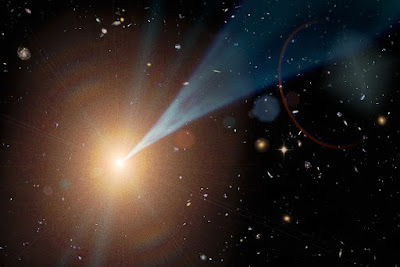
In the disc, debris spins at unfathomable speeds, pulled around by a Black Hole billions of times more massive than our Sun. Friction in the accretion disc generates heat on a level difficult to fully appreciate. Just as hot things glow, the disc does too.
So, brightly it has its own name- A Quasar.

Quasars- Shubham Singh (Universe)
Quasars
 Quasars shine thousands of times more brightly than even the brightest stars.
Not just stars, it's scarier than that Quasar shine thousands of times more brightly than galaxies containing billions of stars.
The first identified Quasar, 3C273, has an absolute magnitude of -26.7,

3C 273 Qusar
 making of it 4 trillion times brighter than our Sun about 100 times more luminous than the amount of light produced by the entire Milky Way.
If you put 3C273 33 light years away from us it would shine as brightly as our Sun a mere 8 light minutes away. Blocking the brightness of a Quasar with the corona graph reveals that the Quasars exist in the centres of galaxies that are larger than them in area, but are nonetheless drowned out by thin light.
Such Galactic centres are called Active Galactic Nuclei.
The bulk of their energy spewing forth in the form of a powerful radiation jet, the length of which puts even our Solar System to shame.
The visible part of the jet in this photograph, for instance, is so long it could stretch from the Sun to Pluto and back, 1 and a half million times.
Now, specifically, if a large portion of this ejection energy heads towards Earth, it's responsible for what we call a Quasar, but if Earth is right and the Active Galactic Nucleus sights, it's got a scarier name; Blazar. 

Blazar- Shubham Singh (Universe)
Blazar

 It's Blazar that clocked in the greatest brightness ever observed.
At historically high levels of activity, it registered in absolute magnitude of -31.4.
To put this brightness of Quasars in yet another perspective, take a look at the one hundred thousandth picture snapped by the Hubble Telescope.


Monday, 17 April 2017

Dazzling thing in the Universe {Part -2}

Welcome to the Series of Dazzling thing in the Universe:- (Part -2)

R136a1 is the most massive star ever found and it's also the brightest.
Remember that lower absolute magnitude are brighter.
R136a1 isn't 4.8, like our Sun, it is -12.6, which means it is 8.7 million times brighter than our Sun.
But R136a1 isn't the brightest thing out there.
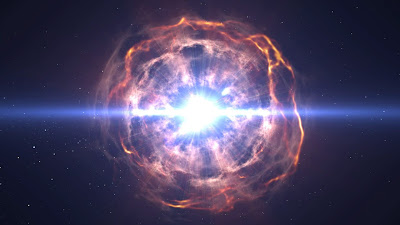
When a giant star dies, it explodes violently in what is known as a Supernova.

Supernova- Shubham Singh (Universe)
Supernova
As I mentioned in my previous series "Hottest thing in the Universe".
Supernovas eject terrifying flashes of radiation known as Gamma-ray bursts.

Arguably, the brightest electromagnetic events in the Universe.
A typical Gamma-ray burst releases as mush energy in a few seconds as our Sun will release altogether in its entire 10 billion years lifetime.

Gamma Ray Burst- Shubham Singh (Universe)
Gamma Ray Burst
If WR104 a Gamma-ray burst future candidate directly struck Earth with such a beam for 10 seconds astronomers predict it could deplete 25%of our ozone layer and lead to mass extinction and starvation.
The largest thermonuclear bomb ever detonated didn't do anything close to that and it was exploded right here in our atmosphere.
Where WR104 is 8,000 light years away. You can't even see it with your naked eyes or pair of binoculars.
But Gamma-ray bursts are merely brief events lasting only a few minutes at most, sometimes, just a matter of milliseconds. If you want the brightest sustained thing, you'll paradoxically have to look at the darkest thing.
Black holes (do check out my another series" Journey to the Black Hole") to be fair, dark matter is ostensibly darker.
But because dark matter has been hypothesised to not even interact with light, with electromagnetism at all, calling dark matter "not bright" is kind of like calling your Pancake "a not fast aeroplane".
It's not really even in the same category Black Holes, however do interact with light, reflecting so little, well they don't let any escape, at least not in a form resembling the way it came in.
That's dark. But the intense energies created by Black Holes in the process of eating things like Stars is anything but dark.
Gas and debris from the stars they eat swirl into Arcpluvian Cosmic gallows known as Accretion Discs.

Accretion Discs- Shubham Singh (Universe)
Accretion Discs

Saturday, 25 March 2017

Dazzling thing in the Universe (Series)

Click the images to get further results:-

Part - 1 - Shubham Singh (Universe)
Part- 1
Part - 2 - Shubham Singh (Universe)
Part - 2 

Part - 3
Part - 4 - Shubham Singh (Universe)
Part - 4
Part - 5

Dazzling thing in the Universe {Part -1}

Welcome to the Series of Dazzling thing in the Universe:- (Part -1)
Yin Yang- Shubham Singh (Universe)
Yin Yang
The above symbol is called Yin Yang, it is a Taijitu meaning diagram of the supreme ultimate.
The principle of Yin Yang opposites existing in harmony, is associated with ancient Chinese philosophy.
But the very first use of the iconography the class symbol,, actually comes from a Shield pattern used by the ancient Romans 700 years before.
Its first known use in China.
A connection between the two yet to be found. Regardless of who came up with it first, the symbol was a bright idea.
But what's the brightest thing in the Universe?
Well, Apparent Magnitude.

Apparent Magnitude- Shubham Singh (Universe)
Apparent Magnitude

Commonly used when stargazing refers to how bright an object appears to us, say when looking up from Earth.
It depends upon Earth-centric factors, like how close the object is to our planet.
Magnitudes are logarithmic and arranged like golf, where a smaller number means a greater brightness.
But today, I'm looking for Absolute Magnitude,  a measure of how bright things all over the Universe near and far would be if we looked at them from the same distance.
Absolute Magnitude will guide us to the most blending light in the Universe, irrespective of it looking faint to us here on Earth, just because its far away.
The difference is significant.
A 100-watt light bulb placed closer than 8 centimetres will appear brighter than the Sun  in the sky. But that's not fair.
If you could see the Sun and the bulb from the same distance, the Sun would be a septillion times brighter.
That's bright.
But the Sun shines punily compared to the rest of the Cosmos.
If you could line up the Sun up with everything else out there giving every star a cosmological phenomena, a fair chance, the Sun's Absolute Magnitude  would 4.8.
But check out R136a1. This star isn't the brightest star in terms of volume but it is 256 times more massive than our Sun.

R136a1- Shubham Singh (Universe)
R136a1
It's the most massive star ever found and it's also the brightest. 

Tuesday, 14 March 2017

Hottest thing in the Universe {Part -4}

Welcome to the Series of Hottest thing in the Universe:- (Part -4)

Okay, what if we add even more energy?
Wouldn't the wavelength get smaller? It's supposed to, but yet it ain't. This is where we've got a problem.
Above 1.41 times to 32 kelvin, the Planck temperature, our theories don't work.
The object would become hotter than temperature. It would be so hot that what it is would not be considered a temperature.
Theoretically, there is no limit to the amount of energy we could keep adding into the system. We just don't know what would happen if it got hotter than the Planck temperature.
Classically, you could argue that that much energy in one place would instantly cause a Black Hole (don't forget to check my other posts- "Journey to the Black Hole") to form.

And a Black Hole formed from energy has a special name- a Kugelblitz.
So, basically, what I'm trying to say is when you want to tell someone you like that you think they are hot,so hot that not even science can understand it, Just call them a Kugelblitz.

Finally, here is something fun.
The Sun is about 4.7 billion years old, about halfway through its life cycle and so far it has burned 100 Earths worth of fuel,
which sounds like a lot, but the Sun is the size of 300,000 Earths.

Planets in our Solar System compared to the Sun- Shubham Singh (Universe)
Planets in our Solar System compared to the Sun

Because of that discrepancy, you can have a lot of mathematical fun comparing your energy output to the Sun's.
The Sun is way hotter than us and it puts out way more energy than us.

The Sun- Shubham Singh (Universe)
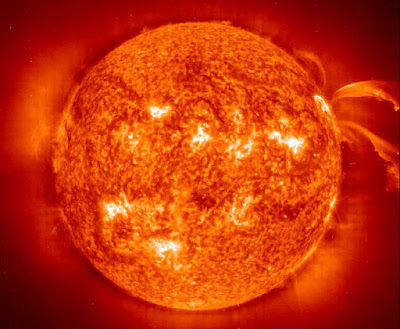
The Sun

Some websites have a lot of fun with this one and although it doesn't really mean anything anything, it is technically true,
because of the Sun's enormous size, that one cubic centimeter of human puts out more energy than an average cubic centimeter of the Sun, which should make you feel quite warm inside.


Saturday, 11 March 2017

Hottest thing in the Universe {Part -3}

Welcome to the Series of Hottest thing in the Universe:- (Part -3)

Let's get hotter. At 1 TeraKelvin things get weird. Remember that Plasma (in Part-2 of the series- Hottest thing in the Universe) we were talking about that the Sun is made of? 
Well at TeraKelvin, the electrons aren't the only thing that wander away. 
The hedrons themselves, the protons and neutrons in the nucleus melt into quirks and gluons, sort of soup.
But how hot is a TeraKelvin? Frighteningly hot.
There's a Star named WR 104, about 8,000 light years away from us. 

WR 104- Shubham Singh (Universe)
WR 104
It's mass is the equivalent of 25 of our Suns and when it dies, when it collapses, its internal temperature will be so great that the energy emitted, the Gamma Radiation it flings out into space will be stronger than the entire amount of energy our Sun will ever create in its entire lifetime.
Gamma ray bursts are quite narrow, so Earth is most likely safe, but what if it wasn't?

Gamma Ray Bursts- Shubham Singh (Universe)
Gamma Ray Bursts

Well, when WR 104 collapses, even though Earth is 4,702 trillion miles away, the energy it releases would still be bad news.
Exposure for 10 seconds would mean losing a quarter of Earth's Ozone layer, resulting in mass extinction, food chain depletion and starvation from 8,000 light years away. 
Closure to home, right here on Earth in Switzerland, scientists have been able to smash protons to nuclei, resulting in temperatures much larger than 1 TeraKelvin = 1,000,000,000,000 K.
They've been able to reach 2 to 12 ExaKelvin range.
1 ExaKelvin = 1,000,000,000,000,000,000 K.
Bet we are okay because those temperatures last for an incredibly brief moment and only involve a small number of particles.
Remember, how we could calculate the wavelength of of the radiation emitted by an object based on its temperature? (in Part - 2 of this Series)
Well if an object were to reach a temperature of 1.41 times to the 32 Kelvin .
                                    (255,000 billion billion billion °F 
                                                                or
                                     141,000 billion billion billion °C)

The Radiation it would emit would have a wavelength of 1.616 times 10 to the negative 26th  nano meters, which is tiny.
Like so tiny, it actually has  special name.
It is the Planck Distance, which according to quantum mechanics, it is the shortest distance possible in our Universe.

Monday, 6 March 2017

Hottest thing in the Universe (Series)

Click the images:-

Part- 1 - Shubham Singh (Universe)
Part- 1

Part- 2 - Shubham Singh (Universe)
Part- 2

Part- 3 - Shubham Singh (Universe)
Part- 3

Hottest thing in the Universe {Part -1}

Welcome to Series of Hottest thing in the Universe:- (Part - 1)

So what is the hottest thing in the Universe?

As we know that there is an absolute zero, but is there an absolute hot?

A point at which something is so hot, it can't get any hotter. Well to find out, let's begin with the human body.

Your internal temperature is not constant at all. 37°C (98.6°F) sure but these are averages. Your body's internal temperature fluctuates by about 1°F or half a °C throughout a day in a cycle.
Assuming you sleep at night, at 4:30 in the morning, your body reaches its coolest natural healthy temperature and at 7:00 in the evening, it reaches its highest.


Regulation of human body temperature- Shubham Singh (Universe)
Regulation of human body temperature

But dangerous fever is not good.
108°F or 42°C is almost always lethal.
The highest recorded air temperature across all of the Earth has happened four times in the Death Valley, where it has reached 129°F (54°C).
180°F (82°C) is the recommended temperature for water, when brewing coffee.
210°F (99°C) a cake is done.
2000°F (1090°C) is the temperature of lava fresh outta the ground.
But you can your own lava, like Green Science Pro. This man uses Fresnel Lenses to focus the Sun's energy onto whatever he wants.

 Keep in mind that the Sun is having that effect even though it is 93 million miles (149,600,000 km) away from Earth.
Right up on the surface of the Sun is a different story. The surface clocks in at 10,000°F (5,500°C),but the centre, where fusion occurs is ridiculous. Temperatures there reach 28 million °F (15 milion °C), which is also known as 15 million kelvin.

The kelvin scale has unit that are the same size as a Celsius degree but it's an absolute, where 0 is an absolute zero.
When matter reaches temperatures as high as those found in the centre of the Sun, an enormous amount of energy is radiated away.

Sunday, 26 February 2017

Journey to the Black Hole {Part -5}

Welcome to the series of Journey of the Black Hole:- (Part - 5)

Where are you in the Universe, do you have any idea?????????
Or, here's a better question, where is the centre of the Universe???
Well, this might sound crazy, but it's everywhere. This is known as Cosmological Principle.

Expanding Universe- Shubham Singh (Universe)
Expanding Universe
No matter where you are in the Universe, everything else will be seen to be moving away from you, expanding at the same rate. The Universe is expanding, but not like a balloon getting bigger with all the people inside it. Instead, it's as if we are the surface of a balloon.
If you were to put a bunch of dots on a balloon and then blow it up, all the dots would move away from each other at the same rate. And, on the surface of the balloon, there s no center.
For instance imagine two layers, they are exactly similar, except the top layer represents a 5% expansion of the bottom layer.
Let's say that you live on one of these dots, and you want to measure where everything is moving away from.
Well, imagine what happens when I line up a dot in a dot n the past and present. It looks like the centre of the expansion. I can do this with any dot.
As soon as I choose a dot to be frame of  reference, it immediately becomes the center of the expansion.
So, while dying in Black Hole would be lonely and scary and morbid, when you look up into the sky instead about this.
No matter where you are, or who you are  or what your friends or your parents, you really scientifically are the center of the Universe.

What if our Universe was a Googolplex ( 10(10100)) metres across? Well it nowhere near that large.
But if it was, it would be so voluminous that statistically, it would not be an exact copy of you somewhere else out there in the Universe.

Saturday, 25 February 2017

Journey to the Black Hole {Part -4}

Welcome to the series of Journey to the Black Hole:- (Part - 4)

It is believed that a moving or spinning Black Hole might create what is known as a "Wormhole" a way of transitioning across space faster than light. 
Not in anyway that violates the laws of science, but in a way that takes advantage of the Universe's dimensions.
For instance, if I wanted to get from one point to the another point, I'd have to travel the distance. But, theoretically, Wormhole would do something really crazy. For instance, this

Wormhole- Shubham Singh (Universe)
Wormhole
Now, the two points are right next to each other and I can travel between them almost instantaneously. But again, this is all theoretical. Luckily, we do have a possible way of analyzing Black Hole right here on Earth
Enter the "Dumb Hole". Just as a Black Hole does not permit light to escape, a Dumb Hole is an acoustic Black Hole.

Dumb Hole- Shubham SIngh (Universe)
Dumb Hole
It won't allow sound to escape. It doesn't have to be nearly as powerful and scientists have been able to create Dumb Holes in laboratories using special fluids travelling at the speed of sound. A lot of progress still needs to be made in the world of acoustic Black Holes, but we may be able to learn an amazing amount of information about Black Holes work by looking at how sound is treated in a Dumb Holes
Now, here's another good question - What would it look to travel at the speed of light, say toward the Sun?
Well surprisingly, you would just see the Sun immediately rush up toward you................
No, no, no...
In fact, initially it would look almost as if the Sun were receding way from you!!!
Why??
Because your field of view would be able to see stuff almost behind you. And here's why.
As you sit there, not moving yet, looking at the Sun, there's light coming from the stuff behind you. But if you travel the speed of light, you will be actually reach that light coming from things behind you. As you reached light speed, your field of view would expand.(like concentrating the stuff in the middle?)