Translate in your Language

Showing posts with label Asteroid. Show all posts

Monday, 16 January 2017

Eris (Asteroid Series) - (Important Facts) {Part-33}

ERIS IS THE MOST MASSIVE dwarf planet in the Solar System and is also the ninth most massive object to directly orbit the Sun.
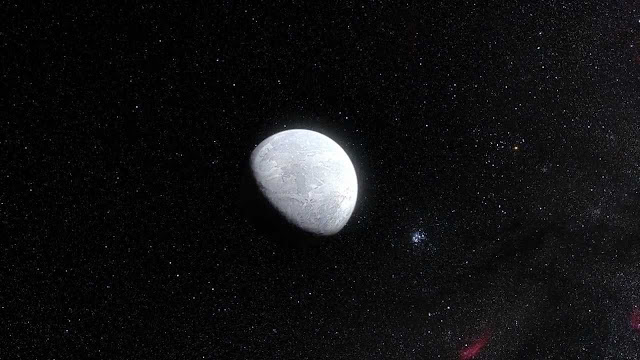
Eris- Shubham Singh (Universe)
Eris
It was discovered in January 2005 by Mike Brown and his team at Palomar Observatory.
If you’re not sure why astronomers suddenly decided that Pluto wasn’t a real planet after all,It’s all because of Eris.
Due to its size, it was initially described as then tenth planet. To avoid adding Ceres and other large object to the planet category, the IAU decided to move Pluto to dwarf planet category.
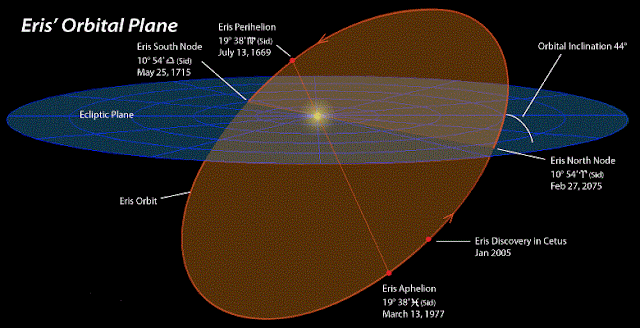
Eris' Orbital plane- Shubham Singh (Universe)
Eris' Orbital plane
Eris is named after the goddess Eris, a personification of strife and discord.
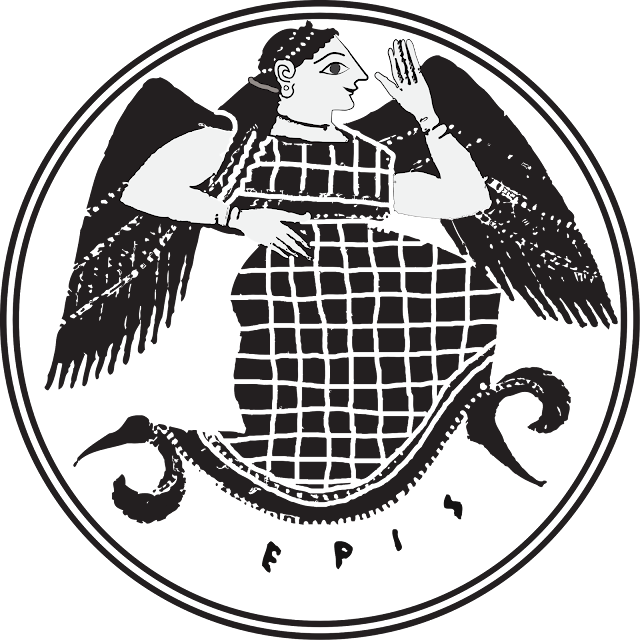
Goddess Eris- Shubham Singh (Universe)
Goddess Eris
The dwarf planet is believed to have a rocky core with outer layers composed of water ice and frozen gasses such as methane. Because of its large size, if it does have a rocky core, it may have sub-surface oceans, heated by radioactive decay.

Sunday, 15 January 2017

Vesta (Asteroid Series) - (Important Facts) {Part-32}

VESTA IS THE SECOND largest asteroid in the Solar System and when it was first discovered, it was mis-classified as a Planet along with the other three known asteroids at the time, Ceres, Pallas and Juno.

Vesta- Shubham Singh (Universe)
Vesta
Its mass totals estimated 9% of all the mass contained in the Asteroid Belt, and like Ceres, it is at least partially differentiated, but it is not classed as a dwarf planet because its mass falls just under the necessary threshold.

Structure of Vesta - Shubham Singh (Universe)
Structure of Vesta
Vesta's most dominant feature is a huge crater, 460km/290mi across, caused by an impact that occurred one billion years ago, resulting in it losing about 1% of its mass. Some of this material eventually found its way to the Earth where it has since been recovered by scientists.

Saturday, 14 January 2017

Ceres (Asteroids Series) - (Important Facts) {Part-31}

Note:- Hello everybody, Welcome to the Series of Asteroids. In this series, Important Asteroids are going to be covered.

THE LARGEST ASTEROID, CERES is classed as a dwarf planet. More than three times the size of the next largest asteroid, Vesta. Ceres comprises a third of the entire Asteroid Belt's mass.

Ceres- Shubham Singh (Universe)
Ceres
When it was first discovered, Ceres was considered to be a theorised planet that existed between Mars and Jupiter.
Later, as more objects were discovered in orbits close to Ceres, it was realised to be discovered in what is now known as the Asteroid Belt.

Structure of Ceres- Shubham Singh (Universe)
Structure of Ceres
When Pluto was demoted to the status of dwarf planet, it caused Ceres to gain the same title as it has similar properties to Pluto. Ceres is currently classed as both an Asteroid and a dwarf planet.

Ceres is at least partially differentiated with a rocky core surrounded by a layer of ice that contains more water than there is fresh water present on the Earth. The surface of the asteroid is covered in a layer of dust.

Due to the vast quantities of water present, it is possible that Ceres could have a liquid ocean sandwich between its rocky core and surface layers of ice and dust. Because of the low temperatures, the water would have to contain impurities that would act as anti-freeze.