Translate in your Language

Showing posts with label Neptune's Moon. Show all posts

Tuesday, 14 February 2017

Proteus (Neptune's Moon) - (Important Facts) {Part-52}

NORMALLY, BODIES OVER ABOUT 200 km/ 125 mi in radius will have sufficient mass to form a sphere, but despite Proteus measuring around 210 km/ 130 mi in radius, it has a very irregular surface, featuring concave depressions and ridges up to 20 km/ 12.4 mi high.

Proteus- Shubham Singh (Universe)
Proteus
The surface is dark and heavily cratered with the largest moon than 250 km/ 155 mi in diameter with a depth of 20 km/ 12.4 mi.
It is likely that Proteus formed from debris cratered by collisions between Neptune's smaller moons, the result of disrupted orbits caused by the capture of Triton

Sunday, 12 February 2017

Neptune's Moon>>>

Click the images to get further results:-

Triton- Shubham SIngh (Universe)
Triton

Triton (Neptune's Moon) - (Important Facts) {Part-51}

THE LARGEST MOON OF NEPTUNE, and comprising 98% of the mass orbiting the planet, Triton is the only the moon in the Solar System to have a retrograde orbit, meaning it orbits in the opposite direction to all other moons.

Triton- Shubham Singh (Universe)
Triton
Because of its orbit, it is thought that the moon was once a Kuiper belt object like Pluto that was captured by Neptune's gravity.
Triton is also one of the few moons of the Solar System to be volcanically active, however due to the very low temperature far from the Sun, its volcanoes erupt water and ammonia rather than liquid rocks.
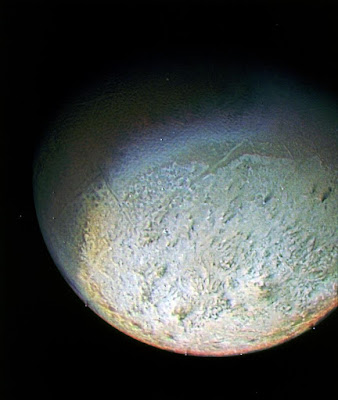
Surface of Triton- Shubham Singh (Universe)
Surface of Triton
It is large enough for its interior to have differentiated into a rocky/metallic core under an icy mantle. The contains enough mass that radioactive decay might be warming it from the inside, which could be responsible for the Cryovolcanic activity.

Cryovolcanic activity- Shubham Singh (Universe)
Cryovolcanic activity
In addition to cryovolcanoes, Triton also exhibits geysers, which erupt with gaseous nitrogen for up to a year at a time.
Triton geysers- Shubham Singh (Universe)
Triton Geysers
Because of constant volcanic activity, Triton's surface relatively young having wiped away almost all signs of impact craters.